🧠 How Your Brain Works
The most complex object in the known universe is sitting inside your skull. This free, visual course takes you from a single neuron all the way up to memory, attention, emotion and sleep — in plain language.
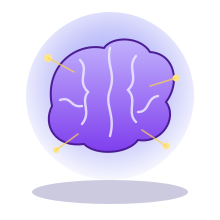
Your brain is about 1.4 kilograms of soft, folded tissue — and it is the most complex object scientists have ever studied. It contains roughly 86 billion neurons, each able to connect to thousands of others, forming trillions of connections. That web is where every thought, memory, feeling and decision happens.
This course zooms in from the whole brain down to a single nerve cell, watches how neurons send electrical signals and chemically talk to each other, and then climbs back up to the big questions: how you remember, how you focus, why you feel, and what sleep is really for. Each of the ten lessons opens with a clear figure and is built to be understood with no prior science.
The single idea to carry through all of it: your brain is not a fixed machine. It rewires itself based on what you do — which is exactly why learning, practice and habits physically change it.
What you'll learn
Try the full interactive course — free
Read the lessons here, or take the same course as interactive, gamified lessons in the app. Free account, your progress saved.
Start the interactive course →Frequently asked questions
Yes. You can read every lesson here for free with no account. A free ManaSaya account lets you take the same course as interactive lessons and track your progress.
No. The course is written for complete beginners — each lesson starts from everyday language and a clear diagram, and builds up one idea at a time.
Ten short lessons, about eight minutes each. You can read them in any order, but they're designed to build on one another.
Free educational content. ManaSaya is a learning platform, not a medical or clinical service.